drawParentToCanvas
← All Butter documentationParameters
drawParentToCanvas()
NOTE: drawParentToCanvas is only available in WebGL mode.
Like p5.js sketches, Butter components generally draw to their own blank canvas. If you clear it, you can see through to the content below. But other times, you don't just want to see the content, you want to read it and do something with it!
In Butter, that's what drawParentToCanvas is for. When you call it, Butter takes a snapshot of the content below the component, and then draws that to your component's canvas. You can call it between the begin() and end() of a framebuffer if you need it stored. Here is an example that just draws it to the main canvas, and then applies a filter shader to it:
let pixelate
function setup() {
  createCanvas(windowWidth, windowHeight, WEBGL)
  pixelate = baseFilterShader().modify(() => {
    getColor((inputs, canvasContent) => {
      let numPixels = 20
      return getTexture(
        canvasContent,
        floor(inputs.texCoord * numPixels) /
          numPixels
      )
    })
  })
}
function draw() {
  clear()
  drawParentToCanvas()
  filter(pixelate)
}
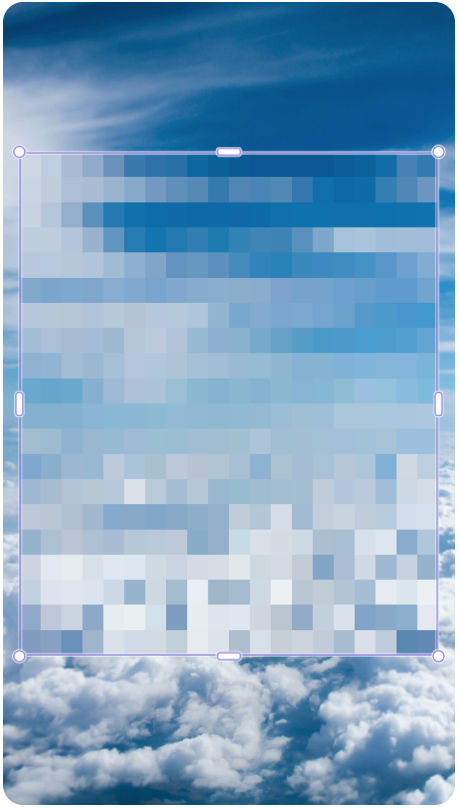
For a more complex example, here the parent content is drawn to a framebuffer, and then sampled in a material shader to produce a glass orb effect:
let refract
let bg
let amount
function setup() {
  createCanvas(windowWidth, windowHeight, WEBGL)
  amount = createSlider(0, 100, 50, 0.1)
  bg = createFramebuffer()
  refract = baseMaterialShader().modify(() => {
    const bgTex =
      uniformTexture(() => bg)
    const bgSize =
      uniformVec2(() => [bg.width, bg.height])
    const refractDist =
      uniformFloat(() => amount.value() / 800)
    let position = sharedVec3()
    let normal = sharedVec3()
    getCameraInputs((inputs) => {
      position = inputs.position
      normal = inputs.normal
      return inputs
    })
    getFinalColor(() => {
      let toSurface = -normalize(position)
      let reflected = reflect(
        toSurface,
        normalize(normal)
      )
      let coord = position.xy / bgSize + 0.5
      coord += reflected.xy * refractDist
      return getTexture(bgTex, coord)
    })
  })
}
function draw() {
  clear()
  bg.draw(() => {
    clear()
    drawParentToCanvas()
  })
  push()
  noStroke()
  shader(refract)
  sphere(min(width, height) * 0.45)
  pop()
}
